
Global Leadership Forecast 2027
AI Readiness: Why Adoption Isn’t the Same as Capability
- Publish Date: October 14, 2026
- Author: GLF Research Team
At a Glance
-
81%
of leaders report productivity gains from AI.
-
18%
of leaders check the quality of AI outputs.
-
10%
of HR professionals say leaders use emerging technology successfully.
Adoption Was the Easy Part. Judgment Is the Work.
Resistance to AI Adoption Is Over
The argument over whether leaders will use AI is settled. Seventy-three percent report it has a positive impact on their work, and 39% are very enthusiastic about using it. Even the group that held out longest has come around. Frontline leaders were the most skeptical population in DDI's 2025 research. Now 67% of frontline leaders are enthusiastic, within a few points of every level above them.
HR professionals report the same pattern. Among ten AI adoption challenges, organizational resistance to adoption ranks last at 14%. Lack of interest ranks third-to-last at 20%. Whatever is holding organizations back, it is not reluctance.
And yet only 10% of HR professionals say their leaders use emerging technologies like AI successfully. Leaders do not dispute it. Just 14% of leaders feel very prepared to use emerging technologies successfully, and only 16% feel very prepared to drive their team's adoption of them.
Everyone is using AI, but almost no one is ready to lead through an AI transformation. That distance between adoption and capability is what AI readiness actually measures: not whether leaders can access the tools, but whether they can use them well and guide a team to do the same.
What the Fluency Gap Looks Like
HR's most-cited obstacle to scaling AI is lack of AI fluency among leaders, named by 54%. Limited understanding of AI capabilities ranks third at 45%. HR is investing accordingly. Over the next three years, HR's largest planned increase in development focus across all skill categories is in leveraging AI effectively, rising from 60% of organizations to 85%. Fostering AI adoption is close behind, up 20 percentage points.
Operating AI tools is the entry point, not the destination.
AI fluency is not just the ability to use the tool or write an airtight prompt. It means applying AI well in the context of your work: knowing which tasks to hand over, when not to, and how to verify what comes back. It also means getting results: time saved, quality that holds up, and ideas that wouldn't have surfaced otherwise. Operating the tools is the entry point, not the destination.
Time saved is easy to judge. Eighty-one percent of leaders report productivity gains from AI, which means they are operating the tools well enough to get real time back.
Quality is harder to discern. Seventy-five percent of leaders say the quality of their work outputs has improved with AI. But only 18% say their leaders check the quality of AI outputs. HR isn't flagging it either. Among ten barriers to scaling AI, too many errors or lack of trust in output ranks ninth at 16%, and ethical concerns about AI use rank seventh at 24%—both in the bottom half of the list from a function that usually names risk first. Taken together, these findings raise a question: is the quality actually better, or does AI apply a veneer that inflates everyone’s confidence?
A Clear AI Policy Gets Leaders Halfway
If leaders aren't reliably judging AI output quality, an organizational policy should set the bar. But most companies haven’t set one—only 22% of leaders say their company has a clear policy on using AI at work. HR ranks the absence of a clear organizational point of view as its fourth-largest barrier at 44%. The effect is substantial. When a clear AI policy exists, AI output quality checking rises from 18% to 50%.
But with clear AI governance, quality control is still a coin flip. Half of leaders working under rules they understand still do not prioritize AI output quality. A policy can tell people what is permitted. It cannot build the discernment to judge whether output is any good.
Eighty-one percent of leaders report productivity gains from AI, which means they are operating the tools well enough to get real time back.
Leaders Are Handing Decisions to AI
Two in five leaders (40%) use AI to analyze data and make decisions. Not just to draft the write-up of a decision—to make it. A decision made with unverified AI input is still the leader's decision. The team affected by it, the customer, and the regulator all hold the leader accountable, not the tool. If the analysis underneath it was flawed, so is the decision.
Leaders’ other uses for AI are less surprising. Enhancing communications leads at 49%, followed by streamlining routine tasks at 46%, and generating ideas at 38%. No single use case breaks 50%, so adoption is wide but shallow. The interpersonal work, by contrast, stays with people. Identifying employee needs sits at 12%, personalizing development at 11%, and monitoring employee performance or engagement at 7%.
The lower use of AI in interpersonal work likely has more than one explanation. First, leaders may be reluctant to let AI weigh in on tasks that require more oversight or carry higher stakes. Second, there is a question of difficulty. Some tasks, like drafting an email, are easy to delegate to AI. Others take real thought to break down or require complex inputs, and far fewer examples show others doing it well.
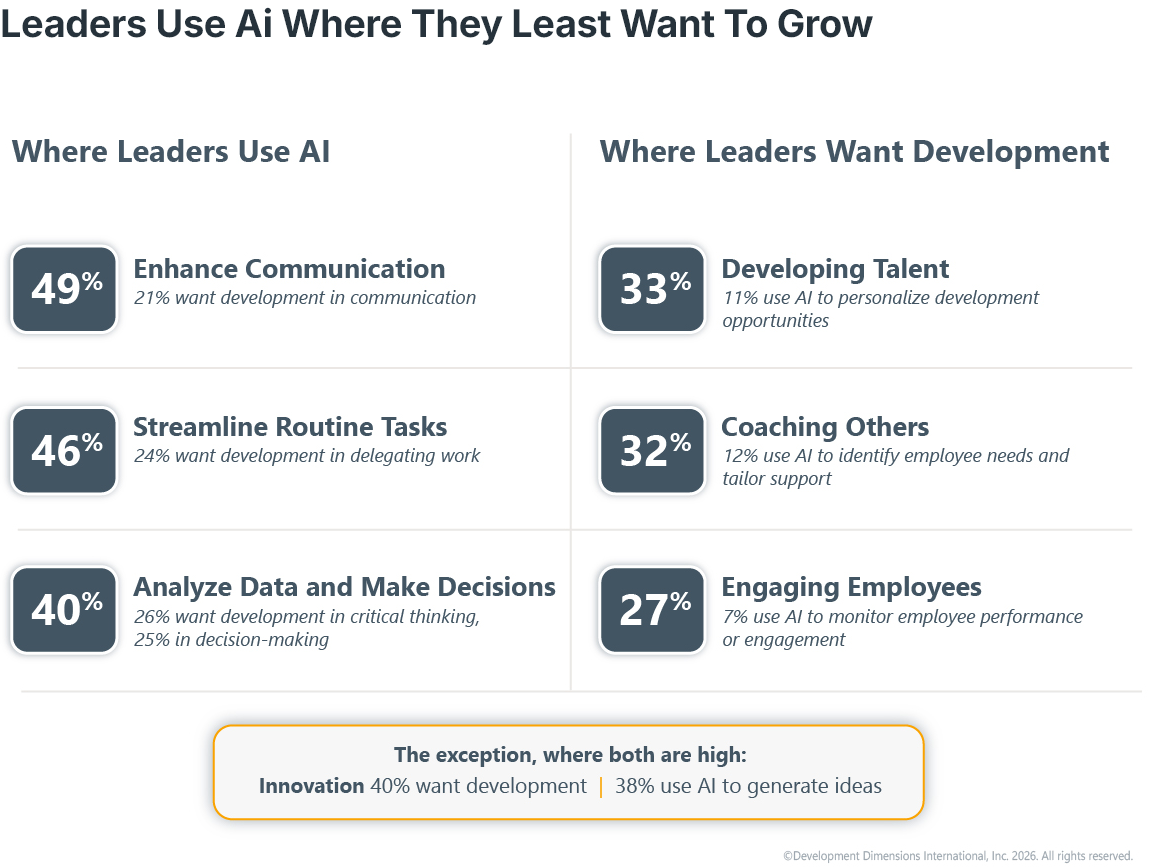
Compare how leaders use AI against the skills they want to develop, and a pattern appears: the heaviest AI use falls in the areas leaders are least interested in developing. Two areas stand out:
- Communication tops the list: Enhancing communications is the most common use of AI at 49%, while communication ranks 13th of 15 in what leaders say they need to develop, at 21%.
- AI decision-making is common: Analyzing data to make decisions sits at 40%, while critical thinking skills ranks 9th at 26% and decision-making skills rank 10th at 25%.
The reverse holds for work that requires working with others: developing talent and coaching others rank near the top of what leaders want to learn, at 33% and 32%, respectively, and near the bottom of what they use AI for, at 11% and 12%.
Innovation is the one clear exception. Idea generation is a forgiving application: there is no single correct output to verify, which lowers the barrier to trying it. Thirty-eight percent of leaders use AI this way. Driving innovation is also the capability leaders most want to develop, at 40%, and it sits in HR's top tier of three-year investment priorities. Leaders want to get better at driving innovation, and generating ideas is an easy way to put AI to work.
Checking the Work Is What Teaches Leaders They Need Critical Thinking
That leaves the larger question. If leaders are handing analysis and decisions to AI, why does judgment sit near the bottom of skills they want to develop? One answer is that they haven’t noticed they need it yet.
Leaders who prioritize checking AI outputs are 1.3X more likely to say they want a lot of development in critical thinking. This suggests that looking closely at what AI produces reveals where it falls short. And that’s a strong motivator for sharpening human critical thinking skills.
But judging an AI-drafted message requires knowing what a good message looks like. Evaluating AI's take on a difficult conversation requires knowing how those conversations should go. The baseline skill is what makes review possible, which puts the capabilities leaders rank quite low (communication, coaching, conflict) in a different light. They aren't just skills AI can substitute for. They're the standard against which AI's work gets measured.
Leaders who prioritize checking AI outputs are 1.3X more likely to say they want a lot of development in critical thinking.
Where Tools and Rules Run Out
When organizations act on AI readiness, they reach for tool training and governance. But tool training produces output faster than anyone can check, and even a policy a leader fully understands leaves a coin flip at the moment of judgment. What closes the gap is not another tool or rule. It is leaders who know when to trust AI, when to override it, and how to build that same discernment in the people they lead.
Where To Focus
Building AI Readiness Through Leadership
Tools and rules are necessary but insufficient on their own. The organizations whose leaders use AI well are the ones that built a leadership layer on top of both: senior leaders who model learning, clear expectations for what good leadership looks like, permission to experiment, and deliberate development of the judgment and human behaviors that determine what AI actually produces.
Five Organizational AI Readiness Enablers
Five conditions are significantly associated with leaders using AI and emerging technologies successfully. In order of impact, they are:
- Promoting technology adoption and experimentation
- Providing a clear policy on AI usage
- Demonstrating learning agility at the senior level by seeking and using feedback
- Modeling a culture of learning and development
- Having a clear set of leadership expectations and competencies
When organizations have all five in place, HR is 13X more likely to rate leaders as capable of using AI effectively compared to those that do not. Four of the five conditions describe how senior leaders behave and what the organization expects of its leaders.
Define How AI Fits the Job
Many organizations have left it to individuals to work out where AI belongs in their work. Until that expectation is defined—which decisions AI supports, what good use looks like, who is accountable for the output—AI use stays discretionary. And discretionary tools get used unevenly. That is what the data shows: wide, shallow use concentrated in the easiest applications, with no shared standard for what good use looks like.
Encouraging use and defining it are different things. Defining it means the role itself specifies where AI belongs: written into the job description, reflected in the competency model, and part of how performance is discussed. It means new leaders are onboarded to AI expectations the way they are onboarded to any other part of the role, rather than picking it up informally.
Planned investment in critical thinking is up 18 percentage points over three years—ahead of what leaders themselves are requesting, and worth pushing further.
None of this means mandating AI everywhere. Leaders are right to hold some work back, and organizations should say so. Naming where human judgment is required is as much a part of the definition as naming where AI helps. The point is to replace a vague expectation with a specific one, because a tool that is merely available competes with every other demand on a leader's time.
Build Leadership Judgment into AI Strategy
The capability at issue is discernment in the moment: when to trust an output, when to override it, and when the stakes are too human to delegate at all. That is a judgment skill, and judgment does not materialize because of a clear AI policy. It is built when leaders practice on realistic problems, with coaching and feedback.
Reviewing AI outputs is one place to start practicing. Leaders need the skill to evaluate what AI produces, and they need to see evaluation treated as real leadership work rather than an extra step. But review only works if leaders know what good looks like in the first place, which means developing the underlying capabilities alongside it. A leader who has never learned how to have a difficult conversation cannot evaluate AI's version of one. That means building the capability and making it visible in what senior leaders do and expect.
HR is already moving in this direction. Planned investment in critical thinking is up 18 percentage points over three years—ahead of what leaders themselves are requesting, and worth pushing further.
When leaders consistently listen and respond with empathy, their team members see a 42% higher rate of productivity from AI.
Don’t Let Interpersonal Skills Fall Off the List
Judgment isn’t the only human capability at stake. Empathy ranks last among the capabilities leaders say they need to develop, but it tracks closely with how much leaders get out of it. When leaders consistently listen and respond with empathy, their team members see a 42% higher rate of productivity from AI, and a 61% higher rate of output quality. But the stakes are rising. Build this capability now, while most AI is still being used on relatively low-risk work. Leaders have largely kept AI out of decisions about people, but that's unlikely to hold. Better to have the judgment and interpersonal skills in place before leaders start applying AI to those decisions.
Have a Question?
FAQs About AI Readiness
-
What does DDI's Global Leadership Forecast 2027 reveal about AI readiness?

DDI's Global Leadership Forecast 2027 finds that AI adoption is no longer the barrier—capability is. While 81% of leaders report productivity gains from AI, only 10% of HR professionals say their leaders use emerging technologies successfully, and just 14% of leaders feel very prepared to use them. AI readiness is a leadership capability gap, not a technology gap.
-
How does using AI differ from being ready to lead teams using it?
Using AI is an individual skill. Leading through AI is a leadership capability that includes judging output quality, deciding when human review is required, and helping a team adopt new ways of working. In DDI's research, 14% of leaders feel very prepared to use emerging technologies successfully, and only 16% feel very prepared to drive their team's adoption of them.
-
What barriers to organizational AI readiness do HR leaders report?
The AI adoption challenges HR professionals cite most are lack of AI fluency among leaders and data security and privacy concerns, both at 54%, limited understanding of growing AI capabilities at 45%, and lack of a clear organizational point of view on using AI at 44%. Organizational resistance to adoption ranks last at 14%.
-
What does the research show about AI policies and checking output quality?
Only 22% of leaders say their organization has a clear policy on using AI at work. Clear policy improves behavior substantially: when a clear policy exists, the share reporting that AI output quality gets checked rises from 18% to roughly 50%. Policy helps, but it does not close the gap on its own.
-
Which leadership behaviors and organizational conditions are associated with effective AI use?
DDI identified five organizational conditions associated with effective AI use: promoting technology adoption and experimentation, a clear AI usage policy, senior-level learning agility, modeling a culture of learning, and clear leadership expectations. At the individual level, leaders whose managers consistently listen and respond with empathy report a 42% higher rate of very positive AI impact on productivity and a 61% higher rate on output quality.