


Summary
Successful AI transformation depends on more than technology adoption. Leaders must build trust, guide teams through uncertainty, support learning, and make sound decisions as ways of working evolve. This article explores five essential leadership capabilities that help organizations close the gap between AI ambition and real business impact.
Everywhere you look, artificial intelligence tools are promising to make work faster, smarter, and more efficient. But as organizations invest, many are discovering that new tech does not equal organizational readiness.
Teams are wrestling with uncertainty. Leaders are unsure how to prepare. And the gap between AI ambition and reality is widening. So what will it take to help leaders guide their teams and organization through AI change? In this article, you’ll find a practical framework for diagnosing AI leadership needs and the five essential capabilities leaders need to support their teams through rapid change.
Why AI Transformation Requires Leadership, Not Just Technology
Right now, most companies are focusing on two areas of AI readiness: AI acumen, the technical skills people need to use the tools, and AI governance, which includes the policies and safeguards that guide their use.
While these are critical, they’re not enough. The missing piece holding organizations back from achieving real transformation is AI leadership: the ability to lead people through AI-enabled disruption. And it’s often overlooked in the rush to adopt technology.
Some leaders feel the pressure caused by this gap more than others. According to DDI’s research, frontline leaders are 3X more likely than senior leaders to be concerned about AI. That’s likely because they carry the heaviest burden when it comes to:
- Adopting new tools
- Addressing anxiety and job fears
- Redesigning workflows
- Reskilling teams
But this trend isn’t a dead end. Leaders who trust senior management are 2.2X more likely to feel excited about AI and the possibilities it creates. In other words, the biggest barrier to successfully deploying AI isn’t technology—it’s leadership capability.
To unlock AI’s full potential, organizations must invest in the human skills leaders need to guide their teams through AI change.
The Leadership Challenges Behind AI Readiness
AI adoption is a leadership challenge at its core. While technology evolves quickly, the obstacles that slow AI progress sit squarely with leaders’ ability to guide people through change.
Employees are understandably anxious about how AI will reshape their roles and futures. Fear of becoming obsolete (FOBO) creates friction as teams try to adapt, learn new tools, and redefine how work gets done. Leaders play a critical role in helping people navigate this uncertainty by building trust, creating psychological safety, and making it safe to experiment and learn.
But the challenge goes beyond emotional readiness. AI is also placing new practical and strategic demands on leaders—demands many are not yet equipped to meet. Leaders must:
- Decide where AI should be used (and where it shouldn’t)
- Shape AI strategy to fit their teams, business, and customers
- Translate strategy into clear workflows, decisions, and expectations
Without this clarity, teams are left unsure how AI fits into their day-to-day work.
This is where leadership becomes make-or-break. Without the right leadership capabilities to address both the human and practical dimensions of AI change, AI investments stall in “pilot mode,” adoption slows, and trust erodes.
What often gets labeled as “resistance” is usually a symptom of leadership gaps. It can look like:
- Lack of understanding about how and why AI is being used
- Lack of psychological safety to experiment and learn
- Lack of clear communication about changing roles and expectations
- Lack of trust in leadership direction
HR and L&D teams are uniquely positioned to help close those gaps by equipping leaders with the skills to communicate clearly, make sound judgments about AI use, and guide their teams through disruption.
The question isn’t, “How do we train leaders on AI tools?” It’s, “How do we prepare leaders to lead effectively in an AI-enabled world?”
A New Framework for AI Leadership
To help L&D and HR understand what leaders truly need in the AI era, we created the “AI Leadership Context Matrix.” This framework clarifies how leadership requirements shift across different organizational realities.
Leadership needs differ across three dimensions:
- AI maturity stage
- Leadership level
- Functional role
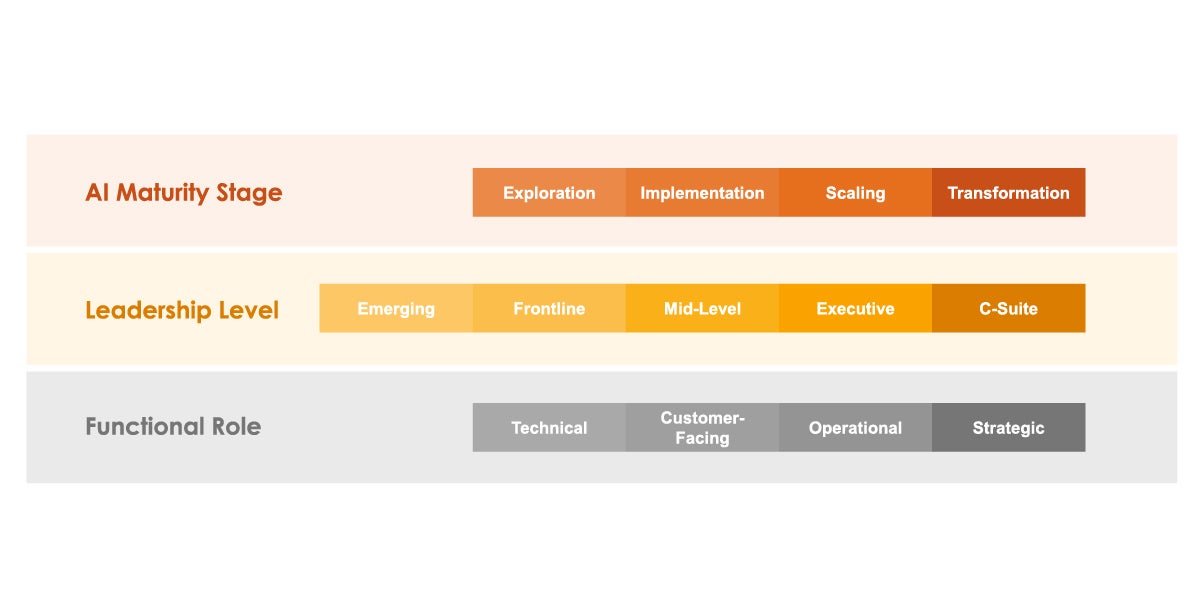
Each factor influences the skills leaders need to support successful AI adoption. Let’s walk through each one so you can diagnose where your organization and leaders should focus.
⤷ Leadership Needs at Every Stage of AI Maturity
Organizational AI maturity is the starting point because it defines your broader goals and where leaders must focus at scale.
1. Exploration
At this stage, organizations begin investigating what AI can do and where it fits into their strategy. To make the most of exploration, leaders need:
- Basic AI literacy
- Strategies to manage uncertainty
- Skills to address fear and confusion
- Early norms and boundaries for ethical use
These capabilities help leaders reduce fear and build early trust, creating a strong foundation for future AI progress.
2. Implementation
Early pilots and use cases are deployed during this phase. To ensure adoption, leaders must:
- Demonstrate business value
- Encourage experimentation and early adoption
- Help employees translate AI capabilities into their work
- Communicate why AI matters now
- Manage change resistance and concerns
The challenge for leaders is moving AI from promise to practice by showing teams how the tools meaningfully improve their work.
3. Scaling
As AI expands across teams, functions, and workflows, leaders need:
- Cross-team coordination and collaboration
- Skills to redesign processes and workflows
- Partnership with technical teams
- Consistency while still flexing for local needs
- Ability to apply AI in diverse contexts
The challenge for leaders at this stage is driving cross-functional alignment through clear, consistent communication.
4. Transformation
AI becomes part of the operating models and long-term strategy. While work is being reimagined, leaders must:
- Balance human work and AI contributions
- Set ethical guidelines and use them to make decisions
- Lead workforce transformation
- Shape long-term strategic vision
Success in the transformation stage relies on leaders balancing innovation with risk, purpose, and culture.
⤷ What AI Readiness Looks Like at Each Leadership Level
AI leadership needs shift depending on where leaders sit in the org chart. Here’s how each level contributes to AI transformation and what skills they must strengthen.
1. Emerging Leaders
Emerging leaders need foundational AI literacy and adaptability as they prepare for roles that will likely look very different in the future. Focus on developing curiosity and a learning mindset.
In action, this might look like:
- Curiosity: Exploring basic AI literacy and preparing for how AI may shape their future responsibilities
- Connection: Building early trust while learning alongside peers and team members as AI tools emerge and evolve
2. Frontline Leaders
Frontline leaders are the most concerned—and most impacted by AI leadership challenges—because they directly shape employee perceptions of AI. They must communicate clearly, manage resistance to change, and build psychological safety.
In action:
- Connection: Addressing team fears directly and creating space for open dialogue
- Clarity: Explaining why AI tools are being introduced and how workflows will change
3. Mid-Level Leaders
The focus for mid-level leaders is translating AI strategy into execution. They coordinate across functions, redesign processes, and ensure teams are aligned on priorities and outcomes. They must understand AI’s broader impact while also supporting practical needs.
In action:
- Creativity: Reimagining processes and cross-functional workflows
- Clarity: Aligning multiple teams on goals and shared expectations
- Curiosity: Exploring new opportunities surfaced by AI tools
4. Executive Leaders
Executives oversee enterprise-wide AI integration and must balance innovation with risk. They set direction, allocate investments, and champion responsible AI leadership and adoption.
In action:
- Conscience: Establishing ethical boundaries and governance expectations
- Creativity: Driving enterprise-level innovation and transformation
- Clarity: Communicating strategic rationale and measuring value
5. C-Suite
C-suite leaders set the long-term strategic vision for AI and ensure it aligns with organizational purpose. They shape culture, accountability, and ethical frameworks.
In action:
- Conscience: Defining organization-wide principles for responsible AI
- Clarity: Articulating the long-term AI vision and future-state narrative
⤷ AI and Leadership by Functional Role
AI impacts every function differently. Leaders must tailor their approach based on how AI reshapes the work their teams do. Each function faces distinct pressures, risks, and opportunities, which means the leadership capabilities for AI readiness differ as well.
1. Technical Functions
Technical teams sit at the heart of AI innovation. Their main challenge is balancing experimentation with practicality while ensuring that new capabilities support business needs. They need leaders who can connect technical potential to business value, navigate ethical considerations, and steer teams toward responsible development.
Examples:
- Creativity: Designing novel solutions enabled by emerging AI capabilities
- Conscience: Ensuring fairness, safety, and alignment with organizational values
2. Customer-Facing Functions
Customer-facing roles must manage the tension between human connection and AI personalization. These leaders must demonstrate empathy, build trust, set expectations for AI-enabled interactions, and maintain authentic customer experiences.
Examples:
- Connection: Preserving the human experience while leveraging AI insights
- Clarity: Setting expectations for how AI augments, not replaces, customer relationships
3. Operational Functions
Operational teams face big disruptions as AI reshapes workflows, processes, and roles. Their challenge is navigating workflow redesign while keeping people engaged. These leaders need solid change management skills: helping people understand new processes, supporting them through transitions, and iterating quickly.
Examples:
- Clarity: Translating complex process shifts into clear expectations
- Connection: Supporting employees through significant change
- Curiosity: Testing and adapting new workflows
4. Strategic Functions
Strategic functions are responsible for imagining the future and making bold choices about where the organization is headed. That’s why these visionary leaders must balance innovation with ethics and purpose when envisioning new business models.
Examples:
- Creativity: Envisioning new possibilities for the business
- Conscience: Ensuring AI-driven strategies align with organizational purpose and ethics
- Curiosity: Exploring emerging opportunities and scenarios
The 5Cs of Leadership in the AI Era
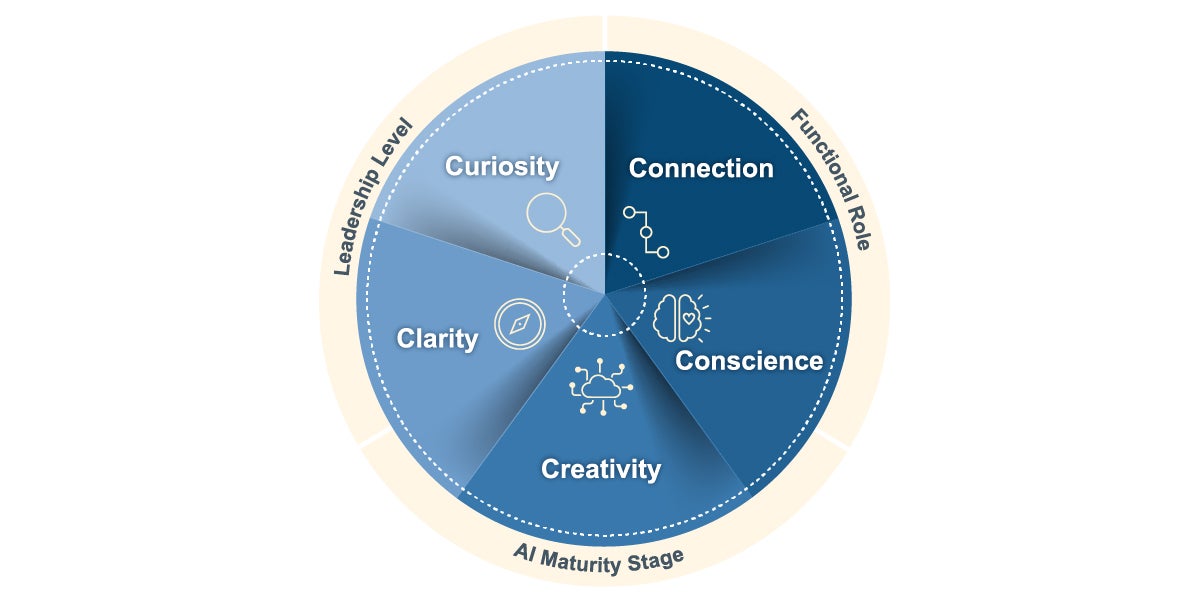
AI transformation and the complexities it brings to leadership can feel overwhelming. But there are clear themes to anchor your leadership development strategy. At DDI, we define the 5Cs of Leadership in the AI Era as the essential skills leaders need to focus on: connection, conscience, creativity, clarity, and curiosity.
1. Connection: The Human Anchor in a Tech-Driven Era
Connection is the empathy, trust, psychological safety, and relationship-building that holds teams together. As AI becomes more pervasive, human connection is what sets leaders apart.
It also shapes whether AI pays off. According to DDI's Global Leadership Forecast 2027, when leaders consistently listen and respond with empathy, team members are 1.3X more likely to see productivity gains from AI and 1.4X more likely to see improved output quality.
In action, this might look like:
- Listening to concerns and responding with empathy
- Addressing fear and job anxiety
- Creating safe spaces for experimentation
- Building collaboration across technical and business teams
- Inspiring commitment to a shared AI vision
2. Conscience: Ethical Judgment in the Age of Intelligent Machines
AI introduces new ethical dilemmas and magnifies existing ones. That’s why leaders need strong moral judgment—based on integrity, fairness, responsibility—to guide decisions and set expectations for responsible AI use.
In action:
- Making values-based decisions on data collection and use
- Setting boundaries for when and how AI should be used
- Spotting and addressing bias
- Taking responsibility for AI outcomes
- Establishing guardrails for teams
3. Creativity: Reimagining Work, Not Just Optimizing It
AI can optimize what already exists, but it can’t imagine the new. Leaders need creative problem-solving skills and a transformation mindset to envision new possibilities.
In action:
- Seeing beyond automation to true reimagination
- Integrating AI insights with human insight
- Encouraging experimentation and innovation
- Building new workflows rather than digitizing old ones
- Asking, “What’s possible now?”
4. Clarity: Navigating Ambiguity in a Complex AI Landscape
AI brings complexity, black-box systems, and information overload. Leaders must provide clarity through sensemaking, decision-making, communication, and direction-setting to help teams move forward confidently.
In action:
- Translating complex AI concepts into accessible narratives
- Helping teams focus on meaningful insights
- Making decisions even with incomplete or imperfect data
- Communicating the purpose behind AI changes
- Explaining how AI affects roles, expectations, and priorities
5. Curiosity: The Fuel for Continuous Learning
AI capabilities evolve constantly—so leaders must evolve with them (or risk being left behind). Curiosity means demonstrating a learning mindset, adaptability, and openness to experimentation.
In action:
- Asking deeper questions about AI’s implications
- Challenging outdated assumptions
- Exploring new workflows and opportunities
- Modeling continuous learning for their teams
- Showing comfort with ambiguity and iteration
How the AI Leadership Context Matrix and 5Cs Work Together
While every leader needs all 5Cs, each capability shows up differently depending on a leader’s context.
For example:
- Connection for a frontline leader may mean creating psychological safety during workflow changes.
- Connection for a CEO may mean articulating a compelling enterprise-wide AI vision that inspires confidence.
The capability is the same, but the expression changes. Context determines:
- The behaviors that represent each capability
- The decisions leaders must make
- The stakeholders they influence
- The situations where the capability is tested
This dual-framework approach provides the nuance L&D needs to deliver role-relevant development. It balances emotional, practical, and strategic capabilities, ensuring leaders grow the right skills for their stage, role, and function. And as AI maturity evolves, so does leadership readiness—preparing your leaders for what’s next.
HR and L&D’s Role in Developing AI-Ready Leaders
HR plays a critical role in building the leadership capabilities that make AI successful. Start by using assessments, simulations, and feedback tools to identify leadership capability gaps in the relevant areas. Then, create development pathways tailored to each function, leadership level, and AI maturity.
You don’t need to do it alone. Partner with trusted advisors who can help design contextual, research-backed leadership development that accelerates your organization’s AI transformation.
AI Success Depends on Leadership Capability
AI won’t transform your organization alone. But your leaders will.
Organizations that invest in leadership readiness today will become tomorrow’s AI success stories. Leaders who are prepared to lead through AI change adopt new tools faster, build deeper trust, create more resilient teams, and deliver higher ROI.
Have a Question?
Frequently Asked Questions About AI and Leadership
-
Why is leadership development important in AI transformation?

AI transformation isn’t only a technical shift—it requires a people shift, too. Leadership behaviors determine whether teams trust new tools, adapt workflows, and innovate. Leaders prepared for AI drive faster adoption, stronger collaboration, and higher ROI, making leadership development essential for successful AI transformation.
-
What skills do leaders need for AI?
Leaders need the 5Cs of Leadership in the AI-Era: Connection, Conscience, Creativity, Clarity, and Curiosity. These capabilities help leaders navigate uncertainty, make ethical decisions, reimagine work, communicate purpose, and continuously learn as AI evolves.
-
How does AI impact leadership roles?
AI reshapes every leadership role by increasing complexity, accelerating change, and introducing new ethical dilemmas. Leaders must guide teams through uncertainty, redesign workflows, and translate AI strategy into daily behaviors.
-
How can HR prepare leaders for AI?
HR can prepare leaders for AI adoption by identifying capability gaps through assessments and simulations, then building development pathways tailored to their function, leadership level, and stage of AI maturity. Partnering with trusted advisors helps ensure leaders gain the contextual, human-centered skills they need to drive AI success.