


Summary
A leadership competency framework defines the skills and behaviors leaders need to execute business strategy. By establishing observable key actions and integrating competencies into talent decisions, organizations can develop stronger leaders and prepare them for changing business demands.
Organizations face a critical challenge in today’s complex business environment: ensuring consistent, high-quality leadership at all levels. Without clear leadership standards, companies struggle to align leader expectations, develop talent effectively, and drive business success. A well-defined leadership competency framework provides the foundation for overcoming these challenges by setting clear expectations for leaders and aligning the organization.
A leadership competency framework defines the key behaviors and skills leaders need to succeed. It creates a common leadership language that aligns leaders at all levels, shapes company culture, and reinforces strategic business goals. The right framework makes leadership development intentional, measurable, and impactful.
But the capabilities organizations need from leaders are changing. DDI's Global Leadership Forecast 2027 reveals that 87% of leaders worry their skills are becoming obsolete. As organizations navigate constant change, AI adoption, and shifting business priorities, their competency frameworks must evolve to reflect both emerging demands and the foundational interpersonal skills leaders need to succeed.
What Is a Competency?
A leadership competency is a cluster of behaviors, skills, and attributes that define effective leadership performance. These competencies provide a structured way to assess, develop, and measure leadership effectiveness across the organization. Effective leadership competencies have several key characteristics. These competencies are:
Clearly Defined
A competency should specify the behaviors and skills required for success, rather than providing broad or vague definitions. Without clear definitions, leaders may struggle to understand what is expected of them. Well-defined competencies ensure leaders have a concrete understanding of what success looks like in practice.
Behavioral
Competencies should focus on specific actions and behaviors rather than abstract concepts. Defining behaviors makes it easier for leaders to apply competencies in real-world situations. A behavioral focus ensures that competencies translate into observable leadership actions rather than theoretical ideals.
Observable and Measurable
Effective competencies must be grounded in behaviors that can be seen, assessed, and improved. If competencies aren’t measurable, feedback and progress evaluation become difficult. Making competencies observable allows for objective assessment, targeted development, and meaningful performance conversations.
A leadership competency framework defines the key behaviors and skills leaders need to succeed, and the right framework makes leadership development intentional, measurable, and impactful.
Integrated into Talent Strategies
Use competencies consistently across hiring, promotion, and development efforts. When embedded into talent processes, competencies provide a reliable foundation for making informed leadership growth and advancement decisions. Without this consistency, leaders may experience a disjointed journey—being hired based on one set of requirements, assessed on another, and promoted using different criteria—creating confusion and barriers to development.
Structured for Coaching and Feedback
A strong competency model enables leaders and teams to give structured, actionable feedback. Without a framework, feedback can be vague or subjective. By aligning feedback to competencies required for job performance and success, organizations create a culture of continuous development and accountability.
Appropriately Specific
Competencies should provide clear guidance, with core competencies applicable to all leaders and additional competencies tailored to specific roles and leadership levels. Overly broad competencies lack direction, while overly narrow ones limit adaptability. Key actions help bring competencies to life by defining specific, observable behaviors that drive leadership effectiveness.
Together, these characteristics ensure a leadership competency framework does more than describe effective leadership. They establish a practical standard for evaluating performance, guiding development, and preparing leaders for future responsibilities.
How to Build a Leadership Competency Framework
Building an effective leadership competency framework starts with understanding what your business needs leaders to accomplish. From there, organizations can identify the behaviors that support those goals, validate their importance, and apply them consistently across talent decisions.
1. Align Competencies with Business Strategy
Start by identifying the business challenges leaders must address, both today and in the future. Consider strategic priorities such as managing change, driving innovation, developing talent, and improving organizational performance.
Translate these priorities into specific leadership behaviors that support execution. For example, if organizational transformation is a priority, leaders may need competencies related to navigating change, communicating direction, and building trust.
2. Identify Critical Leadership Competencies
Determine which competencies are essential across the organization and which are particularly important for specific roles or leadership levels.
Balance strategic capabilities with foundational interpersonal skills. DDI's research shows that leaders prioritize innovation, change, and strategy, while trust, communication, and empathy rank near the bottom of their development priorities. Yet these interpersonal skills are essential to putting strategic capabilities into practice.
3. Define Observable Key Actions
Translate each competency into specific behaviors leaders can demonstrate in everyday situations. For example, define effective communication through actions such as explaining decisions, listening to concerns, and confirming shared understanding. By making expectations more concrete, these key actions provide a clearer foundation for assessing, coaching, and developing leaders.
Effective competencies must be grounded in behaviors that can be seen, assessed, and improved. If competencies aren’t measurable, feedback and progress evaluation become difficult.
4. Validate and Differentiate Competencies
Work with business leaders, HR, and other stakeholders to ensure the framework reflects actual job requirements. As part of this process, determine where competencies need to differ by leadership level based on responsibilities and expectations, while avoiding unnecessary complexity.
5. Integrate Competencies into Talent Systems
Use the framework to establish consistent standards across hiring, leadership assessment, development, performance management, and succession planning. By aligning these processes around shared competencies, organizations can make more objective talent decisions while giving leaders a clearer understanding of the skills and behaviors they need to advance.
6. Measure and Update the Framework
Use assessment data, feedback, and performance indicators to evaluate whether competencies are driving the behaviors and business outcomes your organization needs. These insights can help identify gaps, refine development priorities, and determine when the framework needs to evolve.
As business strategies, technology, and leadership expectations change, regularly updating the framework ensures it remains relevant while maintaining clear, consistent standards for leadership performance.
Leadership Competency Framework Examples
A leadership competency framework should reflect both the strategic challenges leaders face and the interpersonal behaviors that help them succeed. The following examples show how broad leadership capabilities can translate into observable actions:
| Leadership Competency | Example Key Actions |
| Leading Change | Explains the reasons for change, addresses concerns, and adjusts plans as circumstances evolve. |
| Building Trust | Demonstrates integrity, follows through on commitments, and encourages open communication. |
| Driving Innovation | Challenges existing approaches, encourages new ideas, and supports thoughtful experimentation. |
| Coaching and Developing Others | Provides actionable feedback, asks questions that encourage reflection, and creates growth opportunities. |
| Setting Strategy | Evaluates business priorities, anticipates future challenges, and aligns decisions with organizational goals. |
| Communicating Effectively | Shares clear expectations, listens actively, and adapts messages to different audiences. |
| Leading Through Ambiguity | Makes informed decisions with incomplete information and helps teams remain focused amid uncertainty. |
These examples demonstrate why leadership competencies must go beyond broad labels. Defining what leaders actually do makes it possible to assess performance consistently and target development where it will have the greatest impact.
Why Key Actions Are Critical for Leadership Competencies
Leadership competencies provide a broad understanding of what great leadership looks like, but to truly develop leaders, we need more than just a definition—we need precision. That’s where key actions come in. Key actions break down a competency into specific, observable, and measurable behaviors that leaders can demonstrate in their daily work. This level of clarity makes leadership development more actionable and effective.
Let’s take a look at an example competency. Here are the key actions for Building Partnerships, where leaders develop and leverage relationships within and across workgroups to achieve results. To do so, leaders must:
- Seek opportunities to build relationships: Proactively engage with others who can support work goals.
- Clarify the shared goal: Align expectations and identify concerns to achieve mutual outcomes.
- Develop ideas collaboratively: Contribute to and expand on the ideas of others.
- Facilitate agreement: Gain commitment from partners, confirm next steps, and identify resource needs.
- Support partners: Prioritize group success and offer resources for shared goals.
- Involve others: Seek input to build alignment and engagement.
- Maintain and enhance self-esteem: Recognize contributions and strengthen relationships.
Key actions bring leadership competencies to life by translating broad concepts into tangible behaviors. By focusing on these specific actions, leaders can build stronger relationships, drive collaboration, and achieve meaningful results. And with this clarity, leadership development becomes more practical, measurable, and impactful, ultimately empowering leaders to grow confidently and consistently.
The need for clear, actionable behaviors becomes even more important as leadership demands intensify. According to DDI's research, only 17% of leaders feel very prepared to anticipate and react to change. Defining the specific behaviors leaders need to navigate uncertainty gives organizations a clearer foundation for assessing readiness and targeting development.
Differentiating Your Leadership Competency Framework by Level
A common question we hear from clients is whether they should differentiate their competency framework by leadership level. The answer? Yes, but only when it truly impacts how leaders apply the competency.
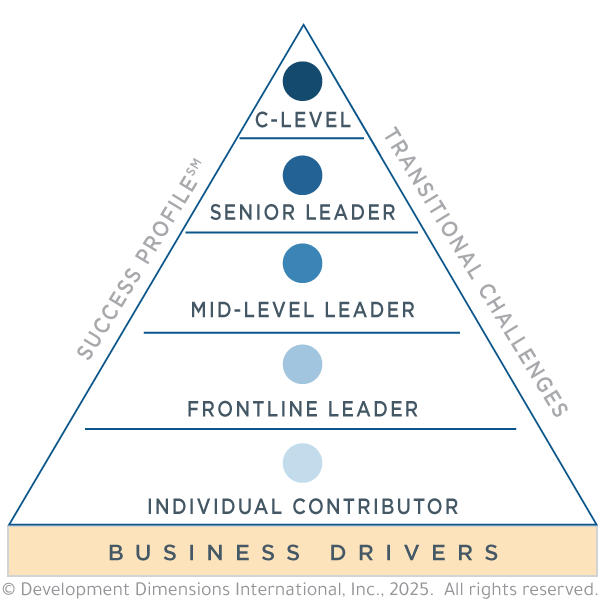
For example, both a frontline leader and a CEO need strong communication skills. However, they use these skills differently. Defining these differences keeps competencies relevant and actionable. Without this clarity, a “one-size-fits-all” approach limits the framework’s effectiveness—whether for selection, succession, or development.
On the other hand, some organizations overcomplicate their frameworks by forcing unnecessary differentiation. Take Coaching and Developing Others, for example. While redefining this competency at the executive level versus the mid-level leader level may seem logical, the core behaviors may remain the same.
The key is intentional differentiation: align competencies with fundamental differences in responsibility and impact, while avoiding artificial complexity. By striking this balance, organizations create a practical and powerful framework.
Importantly, differentiating competencies by level doesn't mean reserving strategic capabilities for senior leaders. Organizations should consider how these capabilities can be developed and applied earlier in the leadership pipeline, even as expectations evolve with greater responsibility.
Making Your Leadership Competency Framework Operational
A well-designed leadership competency framework is one of the most powerful tools for driving leader effectiveness. However, to maximize its impact, organizations must integrate competencies into every stage of the talent lifecycle, including hiring, development, succession planning, and performance management.
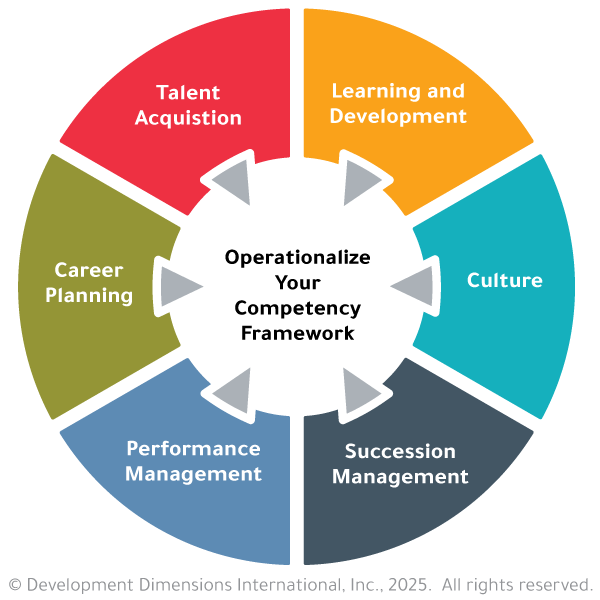
When organizations use competencies throughout these systems, they become the foundation for stronger leaders, better decisions, and sustained business growth. To see the greatest impact, organizations should take an integrated approach—embedding competencies across the full talent lifecycle rather than treating them as standalone elements.
This alignment also strengthens the foundation for measuring leadership capability. DDI's HR Insights Report 2025 found that 78% of HR leaders consider visible behavior change the most valuable measure of leadership development success. A competency framework grounded in observable actions gives organizations a clearer way to evaluate whether development is translating into performance.
When choosing where to start, consider:
- Which operational areas are most critical to the talent process and should be prioritized for competency integration?
- Where do you have momentum?
- Where do you have excitement and stakeholder buy-in to embrace a competency model?
By focusing on these key areas first, organizations can build a strong foundation for embedding competencies across all talent systems and ensure they drive real business value.
When to Update Your Leadership Competency Framework
Once you’ve got your leadership competency framework, how often do you need to update it? Leadership competencies should evolve as business strategy changes. Key triggers for updating a competency framework include mergers, digital transformation, strategic shifts in business goals or focus, and significant industry disruptions. Organizations that fail to realign their framework risk losing focus on the leadership behaviors that drive success.
AI adoption and changing leadership responsibilities make this review especially important. Yet many organizations struggle to balance emerging leadership demands with foundational skills: only 28% invest in both future-focused strategic capabilities and foundational interpersonal skills. Organizations that develop both report stronger leadership quality and greater confidence in their future leadership bench.
Many organizations struggle to balance emerging leadership demands with foundational skills: only 28% invest in both future-focused strategic capabilities and foundational interpersonal skills.
If you don’t re-align your framework when the business strategy changes, you may find yourself without a “North Star” to guide your talent strategies. DDI’s competencies align with business drivers, making it easy for organizations to adjust their framework as strategy evolves, keeping leadership expectations clear and connected to business success.
Regularly reviewing your framework helps ensure that emerging priorities don't crowd out the interpersonal behaviors that make effective leadership possible.
Beyond Competencies: A Holistic View of Leadership Success
While competencies are foundational to leadership effectiveness, they are only one part of DDI’s Success ProfilesSM. By organizing competencies alongside the knowledge, experience, and personal attributes needed for each leadership job, organizations create a holistic picture of job success.
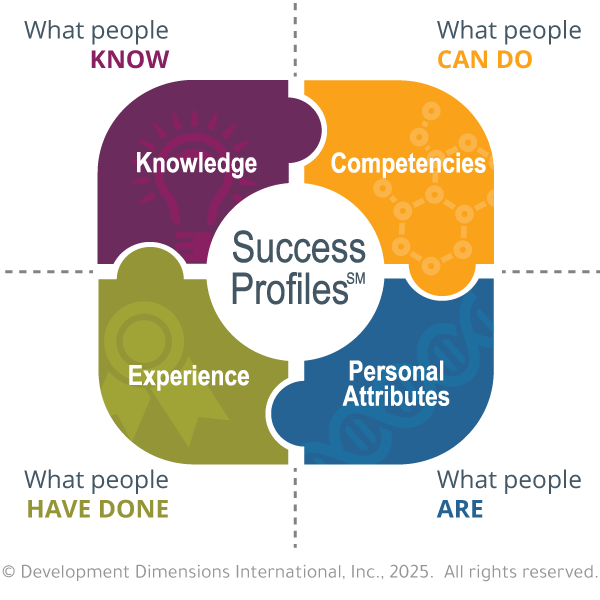
DDI’s Success Profiles include four key elements:
- Knowledge: The technical expertise required for the role.
- Experience: The critical background and practical exposure that prepare someone for the job's responsibilities.
- Competencies: The observable behaviors and skills that drive success in the role.
- Personal Attributes: The inherent traits and characteristics that enable someone to thrive in the role.
From a development perspective, you may focus most on competencies. However, at times, you should incorporate experience, knowledge, and personal attributes to create a more comprehensive development plan and a holistic view of what drives a leader’s success.
For example, if a leader is preparing for a strategic leadership role, development shouldn’t be limited to formal training; it should also include critical experiences such as:
- Leading a cross-functional initiative to gain exposure to different areas of the business.
- Managing through a business transformation or restructuring.
- Presenting strategic recommendations to senior executives.
Similarly, if a frontline leader is preparing for a mid-level leadership role, relevant experiences might include:
- Leading a high-visibility project with increased scope and responsibility.
- Navigating a challenging coaching or performance conversation with a team member.
- Driving a process improvement initiative that impacts business outcomes.
Additionally, personal attributes (e.g., agility, resilience, and motivation) can shape how leaders approach development and adapt to new challenges. By integrating the Success Profile into development planning, organizations can ensure leaders gain the right mix of competencies, experiences, and personal growth opportunities to accelerate their readiness for future roles.
By considering these elements together, organizations can move beyond assessing what leaders know or how they behave today to understanding what they need to succeed in future roles.
Get Started with Your Leadership Competency Framework
An effective leadership competency framework connects business priorities to the behaviors leaders demonstrate every day. But defining those competencies is only the beginning. The greatest value comes from applying them consistently across leadership selection, assessment, development, and succession planning.
Don’t overcomplicate the process or let your framework sit on the shelf. Instead, build a model that is clear, actionable, and aligned with your business strategy.
Remember:
- Focus on specific, observable behaviors that leaders need to demonstrate.
- Differentiate competencies by level only where they add real value.
- Identify key triggers for updating your framework so it evolves with your strategy.
- Make competencies a living part of your talent systems, from hiring to leadership development and performance management.
When leadership competencies reflect what the business needs today and what leaders will need tomorrow, organizations gain a more reliable foundation for developing talent, strengthening their leadership pipeline, and turning strategy into action.
Have a Question?
Frequently Asked Questions About a Leadership Competency Framework
-
What is a leadership competency framework?

A leadership competency framework defines the skills and observable behaviors leaders need to succeed in their roles. It establishes consistent expectations for leadership performance and guides hiring, assessment, development, promotion, and succession planning. Effective frameworks connect these competencies to organizational strategy so leaders understand what success looks like and how to achieve it.
-
Why is a leadership competency framework important?
A leadership competency framework helps organizations align leadership behaviors with business priorities, make more objective talent decisions, and identify development needs. It also creates consistent standards across leadership levels. As business demands change, a well-defined framework helps organizations prepare leaders with the capabilities needed for future success.
-
How do you build a leadership competency framework?
Start by identifying the business priorities and leadership challenges your organization faces. Then select the competencies that support those goals, define observable key actions, and validate them with stakeholders. Differentiate competencies by leadership level where appropriate, integrate them into talent processes, and regularly review the framework to ensure it remains relevant.
-
What competencies should a leadership competency framework include?
A leadership competency framework should include both strategic and interpersonal capabilities. Examples include managing change, driving innovation, setting strategy, building trust, communicating effectively, and coaching others. DDI's Global Leadership Forecast 2027 shows that organizations investing in both strategic and interpersonal capabilities report stronger leadership quality and greater confidence in their future leadership pipeline.
-
How does DDI support building leadership competency frameworks?
DDI helps organizations build research-backed leadership competency frameworks aligned with their business strategies. Its competency library provides a foundation for defining observable leadership behaviors, while Success Profiles℠ connect competencies with the knowledge, experiences, and personal attributes required for success. DDI also helps organizations integrate competencies into leadership assessment, development, and succession planning.