


Summary
To customize leadership training content effectively, organizations need more than branded materials or AI-generated examples. The most impactful leadership development combines personalized learning, organizational context, and evidence-based instructional design to improve engagement, application, and leadership performance.
Organizations have long recognized that leadership development is more effective when it reflects leaders’ real work. But until recently, customizing training content often meant choosing between scalable, off-the-shelf leadership training or expensive, time-intensive custom programs.
Today, advances in AI and new content development approaches are making it easier than ever to customize leadership training content. Organizations can now personalize learning in minutes rather than months. But speed alone doesn't create better learning. Simply asking AI to generate a new case study or swapping company names into existing materials doesn't make leadership development more effective.
The bigger question is this: How do you customize leadership training without sacrificing the leadership science and instructional design that make it effective?
True customization goes beyond surface-level changes. It creates learning experiences that are relevant to individual leaders, reflect the organization's unique context, and are built on evidence-based leadership research and proven instructional design.
Meaningful customization combines three essential elements: personalized learning that reflects individual leaders, organizational context that mirrors business realities, and evidence-based instructional design that drives lasting behavior change.
Why Relevance Matters More Than Ever in Leadership Development
Leadership fundamentals haven't changed. Great leaders still need to communicate effectively, coach employees, build trust, make sound decisions, and lead through change. What has changed is the environment in which those skills are applied. Today's leaders face greater complexity, competing priorities, and constant organizational change, making it more difficult to dedicate time to their own development.
According to DDI's Global Leadership Forecast, only 30% of leaders say they have enough time to fulfill their leadership responsibilities effectively. Meanwhile, 71% report increased stress since stepping into their current leadership role, and among those leaders, 40% have considered abandoning leadership roles altogether. When development opportunities are limited, every learning experience needs to deliver immediate value.
Generic scenarios often fail to resonate because they don't reflect the situations leaders face every day. A manufacturing leader managing production disruptions, a healthcare leader balancing staffing shortages, and a sales manager coaching an underperforming account executive may all be learning the same coaching skill, but the conversations they have, the decisions they make, and the pressures they face are very different.
That's why effective customization focuses on context as much as content. While the underlying leadership behavior remains consistent, the way leaders apply it varies based on their role, industry, and business environment. When learning experiences reflect those realities, leaders can quickly recognize how concepts apply to their own work, making it easier to understand, practice, and use new behaviors on the job.
Organizations aren't simply looking for training that feels customized; they're looking for learning experiences that help leaders perform more effectively in the moments that matter most. That starts with understanding what meaningful customization actually looks like.
What Does It Actually Mean to Customize Leadership Training Content?
Ask ten organizations what customized leadership training means, and many will describe cosmetic changes:
- Adding the company logo
- Updating colors and branding
- Replacing a company name in participant materials
- Revising a few examples or terminology
These updates certainly have value. They create familiarity, reinforce organizational ownership, and help learners recognize that the training was designed for their company. However, they don't fundamentally change the learning experience or make it more relevant to leaders' day-to-day work.
Meaningful customization goes much deeper. It requires organizations to consider not only who is learning, but also the environment they work in and how people learn most effectively. The following three layers provide a framework for creating leadership development that is more relevant, engaging, and likely to drive lasting behavior change.
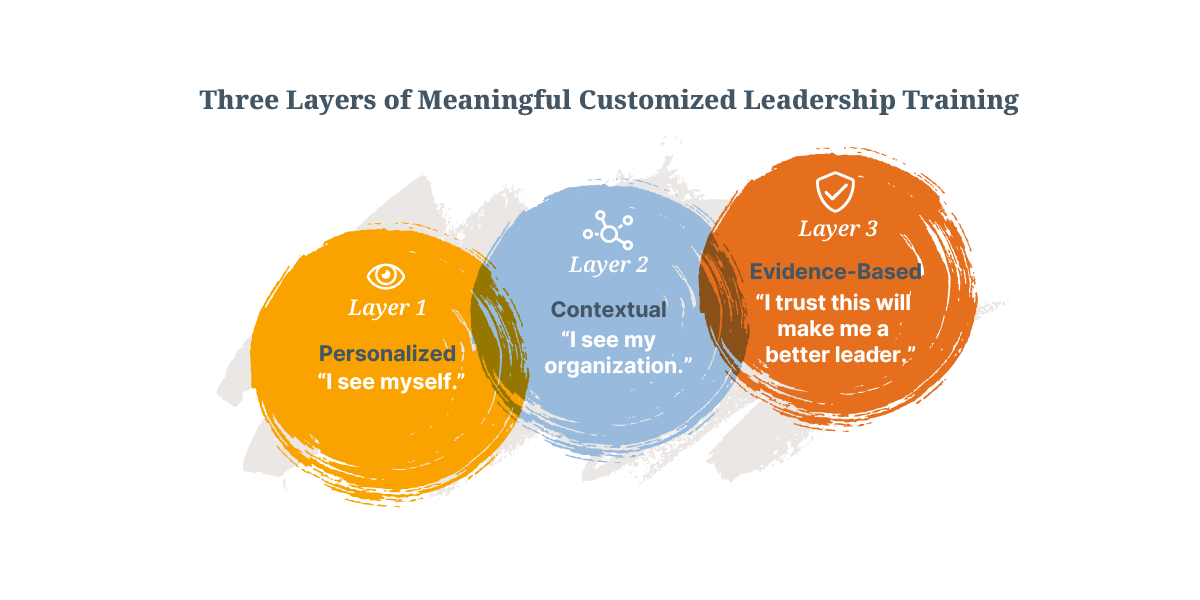
Layer 1: Make Content Relevant to the Learner
The first layer of effective customization begins with the individual leader. Not every leader needs the same examples, activities, or learning path because leadership responsibilities vary significantly across roles, experience levels, and business contexts. A newly promoted frontline supervisor faces different challenges than a vice president leading organizational transformation, and their development should reflect those differences.
High-quality personalized learning content considers factors such as:
- Leadership level (frontline, mid-level, senior leader, executive)
- Role and function
- Current leadership responsibilities
- Skill gaps identified through assessments
- Previous leadership experience
- Immediate development priorities
- Challenges leaders are trying to solve today
Assessments can play an important role in identifying these needs objectively rather than relying on assumptions. Instead of assigning every leader the same curriculum, organizations can use assessment data to prioritize the capabilities that will have the greatest impact for each learner.
Consider a coaching skills workshop. While the core leadership behavior—holding an effective coaching conversation—remains the same, the situations leaders encounter should reflect the realities of their roles. A first-time supervisor may need to address attendance or onboarding challenges, while a manufacturing plant manager might coach an experienced employee through recurring safety concerns without compromising productivity. A retail district manager may focus on improving customer experience across multiple locations, a healthcare leader could navigate coaching conversations within cross-functional patient care teams during staffing shortages, and a sales manager might coach a high-performing employee whose results have declined because of changing market conditions.
When leaders recognize their own experiences in scenarios, discussions, and practice activities, it’s easier to understand how new concepts apply to their work and build confidence using those behaviors on the job. That relevance also increases motivation by helping leaders see the immediate value of what they’re learning.
Layer 2: Make Content Contextual to the Organization
Personalization helps leaders see themselves in the learning experience, but effective leadership development should also reflect the organization they work in.
Many organizations begin by adding their logo, updating colors, or replacing generic company names with their own. Those changes create familiarity and reinforce ownership of the program, but meaningful customization goes much further by embedding the organization's language, priorities, and business realities throughout the learning experience.
Depending on the organization's needs, customization may include elements such as:
- A company’s branding
- A company’s values and leadership expectations
- Internal terminology and industry-specific framing
- A company’s strategic priorities, business goals, and initiatives
- A company’s culture and ways of working
These elements help leaders connect new skills to the decisions they're making every day. For example, a course on managing conflict might use a generic scenario involving two employees disagreeing over project responsibilities. While that's a common leadership challenge, it may not reflect the situations leaders are actually navigating within their own organizations.
The same leadership behavior becomes much more relevant when it's presented through familiar business situations. Manufacturing leaders might practice resolving disagreements about production delays they actually experience on the line while balancing safety, quality, and operational targets. Healthcare leaders could practice working through authentic conflicts clinical teams are experiencing as they manage patient care during staffing shortages. In contrast, retail leaders might practice navigating real customer escalations during specific seasonal demand scenarios. Technology leaders, meanwhile, may focus on facilitating conversations across hybrid teams working through competing product launch priorities.
Grounding learning in familiar business situations makes it easier for leaders to recognize where and how to apply new skills within their own organization.
Organizational context evolves much faster than traditional learning programs. A leadership course developed just a few years ago may no longer reflect today's strategic priorities, market conditions, or workforce challenges. Regularly reviewing and updating examples, scenarios, and activities helps ensure learning stays aligned with business needs and equips leaders to apply new concepts immediately.
Personalization and organizational relevance create a stronger learning experience, but they are only part of the equation. To drive lasting behavior change, leadership development must also be grounded in proven leadership science and instructional design.
Layer 3: Ground Content in Leadership Science and Proven Instructional Design
Customization should make leadership development more relevant without compromising its quality. As organizations look for faster ways to personalize learning, it's easy to focus on creating more content. But effective leadership development isn't measured by the number of scenarios, videos, or activities it contains. It's measured by whether leaders develop new behaviors and apply them successfully on the job.
Achieving that outcome requires two essential foundations: leadership science and instructional design.
- Grounds learning in validated research rather than popular opinion or management trends
- Gives learners confidence they're developing behaviors proven to improve leadership effectiveness
Instructional design:
- Applies proven learning principles to help leaders understand, practice, retain, and apply new concepts
- Prioritizes the highest-impact key actions rather than simply covering more content
These foundations have become even more important as AI transforms how organizations create learning content. Generative AI can quickly produce scenarios, discussion questions, and learning materials, making customization faster and more scalable than ever before.
But AI can't make the instructional design decisions that determine whether learning leads to behavior change. It can't determine which behaviors deserve the greatest emphasis, how learning should be sequenced, or when leaders need opportunities to practice and receive feedback.
Consider the difference in practice: a leader who has only 30 minutes available for development. A generative AI tool might create a lesson covering six different communication behaviors because it can synthesize information quickly. An instructional designer, drawing on leadership science and evidence-based learning principles, would instead identify the single behavior most likely to improve performance in that limited amount of time and design the experience around helping the learner understand, practice, and apply it.
The value isn't simply generating content faster. The value comes from using AI to scale customization while preserving the leadership science and instructional design that make learning effective. When organizations combine leadership research, proven instructional design, and AI-enabled efficiency, they don’t just create more personalized content. They create learning experiences leaders can trust.
AI Can Accelerate Customization, But It Can't Replace Learning Expertise
Artificial intelligence is making it easier and faster to create and customize leadership development. Tasks that once required weeks or months, such as updating learning materials, personalizing learning for different audiences, responding to changing business priorities, and scaling customization across the business, can now be completed much more quickly.
These capabilities make customization faster and more accessible. When guided by leadership expertise, AI can help organizations update learning materials, personalize content for different audiences, and respond more quickly to changing business needs without sacrificing quality. Rather than replacing instructional expertise, AI enables organizations to apply it more efficiently. Leadership research, instructional design, and organizational context should guide what AI creates, not the other way around.
Organizations also don't need to redesign every leadership program from the ground up. In many cases, targeted updates to scenarios, examples, and learning activities can make existing content significantly more relevant while preserving the strength of proven curriculum. AI can help accelerate those updates, allowing organizations to keep learning aligned with changing business priorities without starting over.
Five Practical Ways to Customize Leadership Training Without Starting from Scratch
Customizing leadership training doesn't always require rebuilding an entire curriculum. In many cases, small, intentional updates can make learning more relevant while preserving the quality of existing content. Here are five practical ways to get started:

Start with the right priorities.
Begin by identifying the business challenges leaders are expected to address, then prioritize the leadership behaviors that will have the greatest impact. Aligning development with organizational priorities helps ensure customization supports both organizational goals and individual performance.

Update the examples.
Leadership skills remain consistent, but business challenges evolve. Refresh scenarios, case studies, and practice activities regularly so they reflect current strategic initiatives, workforce realities, and customer expectations.

Incorporate your organization's identity.
Weave your organization's terminology, leadership expectations, values, and brand voice throughout learning materials, not just in the introduction, but within scenarios, discussion prompts, and practice activities. These details help leaders recognize that the content was designed to support the way they work and lead,

Personalize the learner.
Not every leader needs the same development experience. Use assessment results, leadership level, role, or development priorities to tailor learning so leaders focus on the skills that will have the greatest impact.

Keep the content current over time.
Leadership development should evolve alongside the business. Periodically review existing programs to ensure examples, activities, and scenarios still reflect current business priorities, organizational changes, and the challenges leaders face today.
Meaningful customization is an ongoing process rather than a one-time project. By making targeted updates over time, organizations can keep leadership development relevant, practical, and effective without rebuilding every program from scratch.
The Future of Leadership Training Is Personalized, Contextual, and Scalable
Until recently, organizations faced a difficult tradeoff. They could choose scalable leadership training that lacked relevance or invest in highly customized programs that required months of development. Today, organizations no longer have to choose between speed, relevance, and instructional quality because AI has dramatically reduced that tradeoff. However, AI can only deliver effective customization when it's guided by leadership science and instructional expertise.
That's the opportunity behind a new generation of solutions, including DDI's CoLab Studio, which combines AI-enabled efficiency with decades of leadership research and instructional design expertise to help organizations customize leadership training content while preserving the quality and integrity of the learning experience.
Ultimately, effective customization isn't about creating more content—it's about creating learning experiences that reflect the learner, the organization, and the science of how people learn. When those three elements work together, organizations can help leaders learn faster, apply skills with confidence, and perform when it matters most.
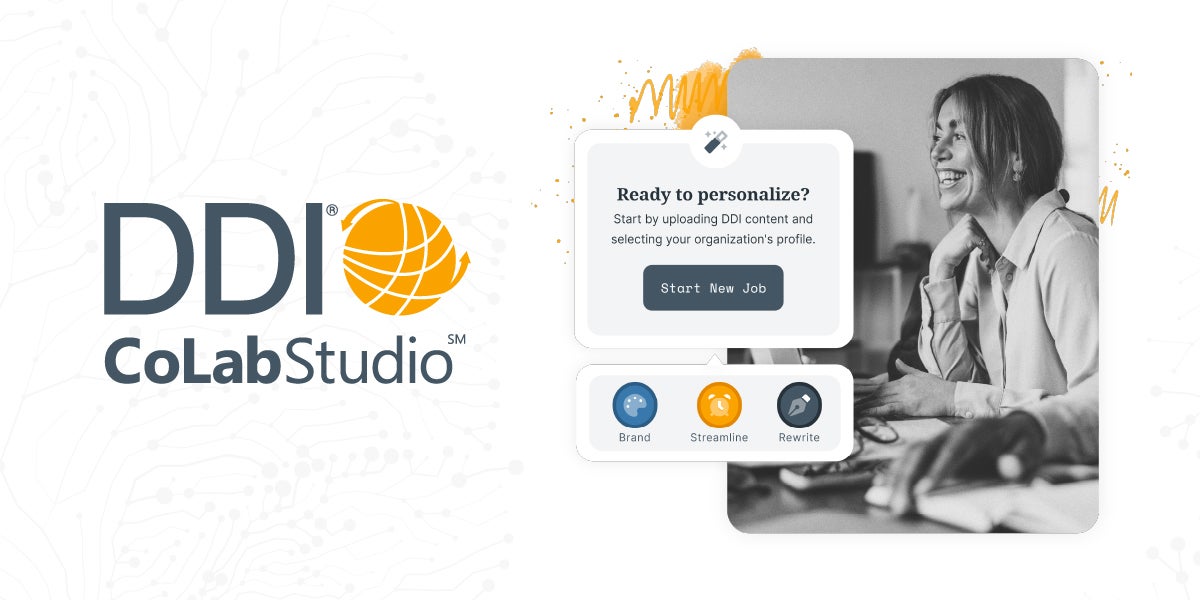
Discover how DDI CoLab Studio helps organizations customize leadership training content with AI-enabled efficiency while preserving the leadership science and instructional design that drive lasting behavior change.
Have a Question?
Frequently Asked Questions About How to Customize Leadership Training Content
-
What does it mean to customize leadership training content?

Customizing leadership training content means adapting learning to reflect the needs of individual leaders, the organization's priorities, and the realities of the business. Effective customization goes beyond logos and branding by incorporating relevant scenarios, personalized learning, and evidence-based instructional design that helps leaders apply new skills on the job.
-
Can AI customize leadership training content?
Yes. AI can accelerate customization by updating learning materials, creating personalized scenarios, and adapting content for different audiences. However, the most effective leadership development combines AI with leadership research, instructional design expertise, and organizational context to ensure learning is both relevant and effective.
-
What's the difference between branded and customized leadership training?
Branded leadership training includes visual elements such as company logos, colors, and terminology. Customized leadership training goes further by incorporating organizational priorities, business challenges, industry-specific scenarios, and personalized learning experiences that help leaders apply new skills in their day-to-day work.
-
How do you personalize leadership training for different leadership levels?
Organizations can personalize leadership training by considering factors such as leadership level, role, experience, development priorities, and assessment results. Tailoring examples, scenarios, and learning activities ensures the content reflects the challenges leaders are most likely to encounter in their specific roles.
-
Does customizing leadership training reduce its quality or instructional integrity?
No. When built on evidence-based leadership research and proven instructional design, customization strengthens learning without compromising quality. AI and other technologies can make customization more efficient, but leadership expertise and sound instructional design remain essential for creating learning experiences that drive behavior change.
Topics covered in this blog