


Summary
Leading through change requires more than a strong strategy or change management process. Leaders need the capabilities to build commitment, address resistance, adapt in real time, and reinforce new behaviors. Organizations can strengthen these capabilities through assessment, targeted development, realistic practice, and feedback.
As the pace and complexity of work have accelerated, organizations are navigating relentless disruption, making leading through change one of the most critical capabilities for today’s leaders. Transformation is no longer episodic; it’s continuous, overlapping, and accelerating. Yet despite unprecedented investment in strategy, systems, and change methodologies, many companies still struggle to achieve lasting change.
The strain is becoming increasingly visible. Nearly 79% of employees report low trust in organizational change, and 39% of leaders say change is a significant source of stress for their teams, according to Gartner. These signals point to a deeper issue: leaders are not keeping pace with the speed and complexity of change.
The reason isn’t a lack of planning or intent. It’s a leadership capability problem. Across industries, leaders are being asked to guide their teams through uncertainty, redesign workflows and sustain performance amid disruption, and help people emotionally commit and practically adapt to new ways of working. But the data is clear: Most leaders simply haven’t been equipped to do this well.
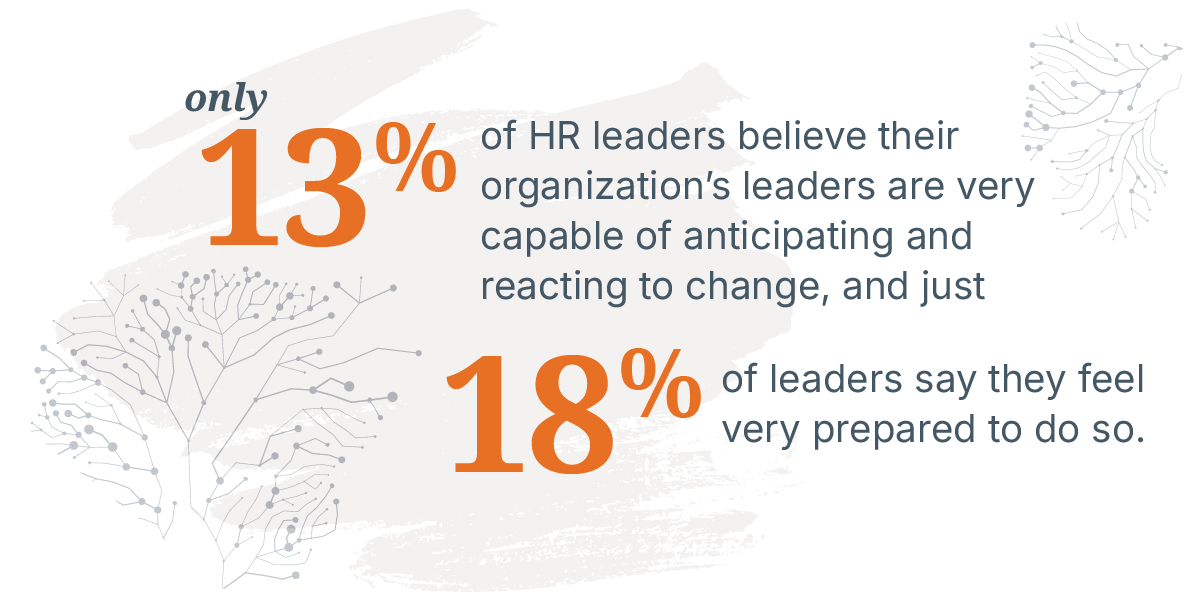
According to DDI’s Global Leadership Forecast, only 13% of HR leaders believe their organization’s leaders are very capable of anticipating and reacting to change, and just 18% of leaders say they feel very prepared to do so. More concerning, the percentage of leaders who feel prepared to manage change has nearly halved over the past five years, from 25% to 13%.
To close this gap, organizations must rethink what it truly means to lead through change, starting with how they develop and prepare leaders to succeed in this environment.
What “Leading Through Change” Actually Means
Leading through change is often confused with change management, but the two are not the same. Change management focuses on plans, processes, timelines, and task execution; leading through change focuses on how leaders drive and sustain organizational change—through direction, culture, and behavior—not just through project mechanics.
At DDI, we define leading change as driving the organizational and cultural changes needed to achieve strategic objectives; catalyzing new approaches that improve results by transforming culture, systems, or products and services; and helping others overcome resistance and commit to new ways of working. It requires leaders to set clear direction and purpose, create momentum for change, build emotional buy-in, and reinforce new behaviors through everyday interactions.
In other words, change succeeds or fails not only at the project-plan level, but at the organizational level through how leaders mobilize action, remove barriers, and reinforce new ways of working as well as how they communicate, respond emotionally, listen, and engage others when uncertainty is highest.
How Leaders Perform at Leading Through Change Today
Unfortunately, leadership capability has not kept pace with the complexity of change leaders now face.
Across levels, our data from more than 100,000 assessments reveals a systemic gap in change leadership capability:
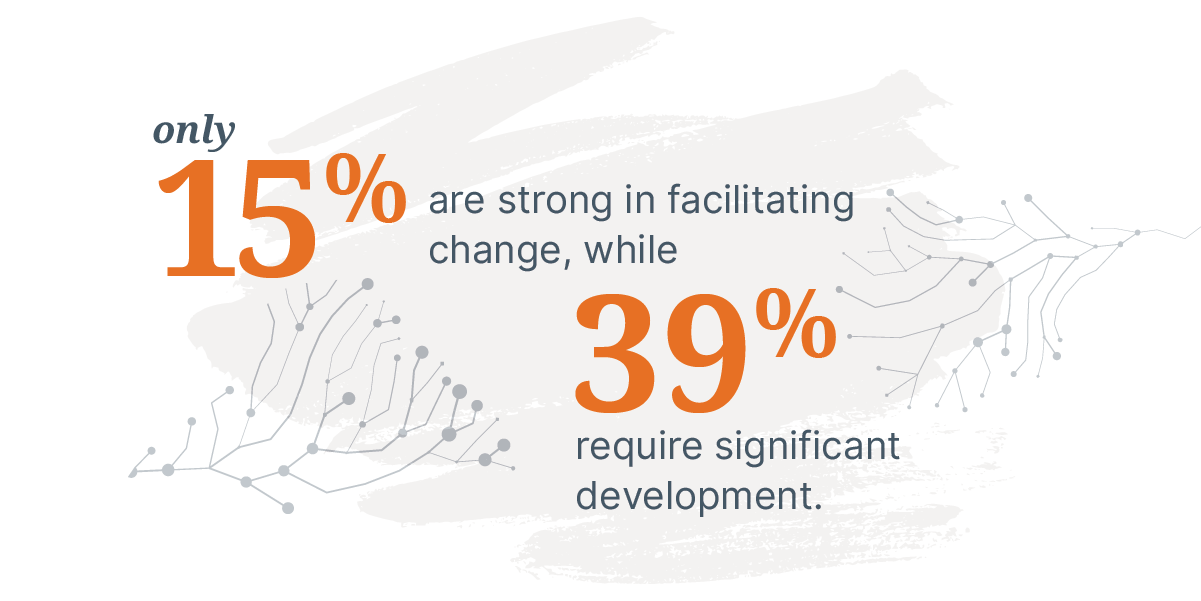
- Emerging and Frontline Leaders: Only 15% are strong in facilitating change, while 39% require significant development.
- Mid-Level Leaders: 30% are strong in leading change, yet one in four still needs significant development.
- Executives: Just 8% demonstrate strong change leadership despite their positional authority.
At no level do leaders demonstrate strong capability to lead change. Experience and authority alone do not build this skill set. This isn’t an individual failing; it’s a critical systemic skill gap.
Even mid-level leaders, who sit at the center of translating strategy into execution, grapple with leading change. While they are often closest to mobilizing action and energizing others, fewer than one-third demonstrate strong overall change leadership capability. This highlights how challenging change leadership remains, even for those with it at the core of their role.
The Hardest Parts About Leading Through Change
To understand why leaders score poorly in leading change, it’s essential to look beyond overall capability ratings and examine which behaviors leaders struggle with most. Across levels, the most fragile behaviors are those that require emotional engagement, empathy, and influence, not authority. While the specific challenges vary by level, clear patterns emerge when we examine the hardest parts of leading change for executives, mid-level leaders, and frontline leaders.
For executives, the biggest breakdowns occur not in setting direction, but in reinforcing and sustaining change through visible action.
⤷ Rewarding change—Executives: 1% strong
Executives are often furthest from day-to-day behavior and may assume alignment happens automatically once direction is set. But when change isn’t visibly rewarded, old behaviors persist, no matter how clear the strategy or messaging may be.
⤷ Stretching boundaries—Executives: 4% strong
Experimentation and challenging entrenched norms can feel risky at senior levels. Executives may worry about disrupting short-term performance or may themselves be comfortable with existing models. Without leaders willing to stretch boundaries, innovation stalls and transformation loses momentum.
⤷ Addressing change resistance—Executives: 11% strong
Senior leaders are often shielded from dissent and may experience resistance as personal or disruptive. Yet resistance doesn’t disappear when ignored; it goes underground, quietly eroding trust and commitment.
Mid-level leaders face a different challenge—one shaped by constant pressure to execute.
⤷ Asking questions—Mid-level leaders: 10% strong
Mid-level leaders are under constant pressure to execute quickly, which can reward answers over curiosity. Stuck between competing demands from above and below, they may default to action rather than inquiry. But without asking questions, leaders miss early warning signs and disengage the very people needed to make change work.
For frontline and emerging leaders, the challenge is mobilizing others without formal authority.
⤷ Actively engaging others in change initiatives—Frontline and emerging leaders: 13% strong
These leaders often have limited authority and may feel unclear about their role in driving change. Without confidence or the capability to mobilize others, change fails to reach the moments that matter most and where work actually happens.
A clear pattern emerges: Across levels, leaders struggle to engage people emotionally by communicating why change is necessary and listening deeply to how others are experiencing it. When leaders fail to explain the purpose behind change, resistance grows, engagement drops, and old behaviors persist regardless of how sound the strategy may be.
In other words, leading change breaks down not at the strategy level, but primarily in the day-to-day human interactions where trust, understanding, and commitment are built.
Why Leading Change Has Become More Difficult Over Time
One signal that change leadership has become more difficult lies in who feels most prepared to lead change today. Leaders who operate in faster, more fluid environments report higher readiness than those navigating more constrained systems. This suggests that exposure to ongoing change and the ability to adapt in real time may help build change leadership capability.
At the same time, the overall leadership role has expanded dramatically. Over the past decade, leaders have been asked to do more—and to do it faster—while navigating near-constant disruption rather than episodic change. In addition to delivering results, today’s leaders are expected to manage work, coach performance, support employee well-being, and guide teams through ongoing uncertainty, all at once. While these expectations were already rising, the pandemic dramatically accelerated their pace and intensity, compressing years of change into a much shorter period.
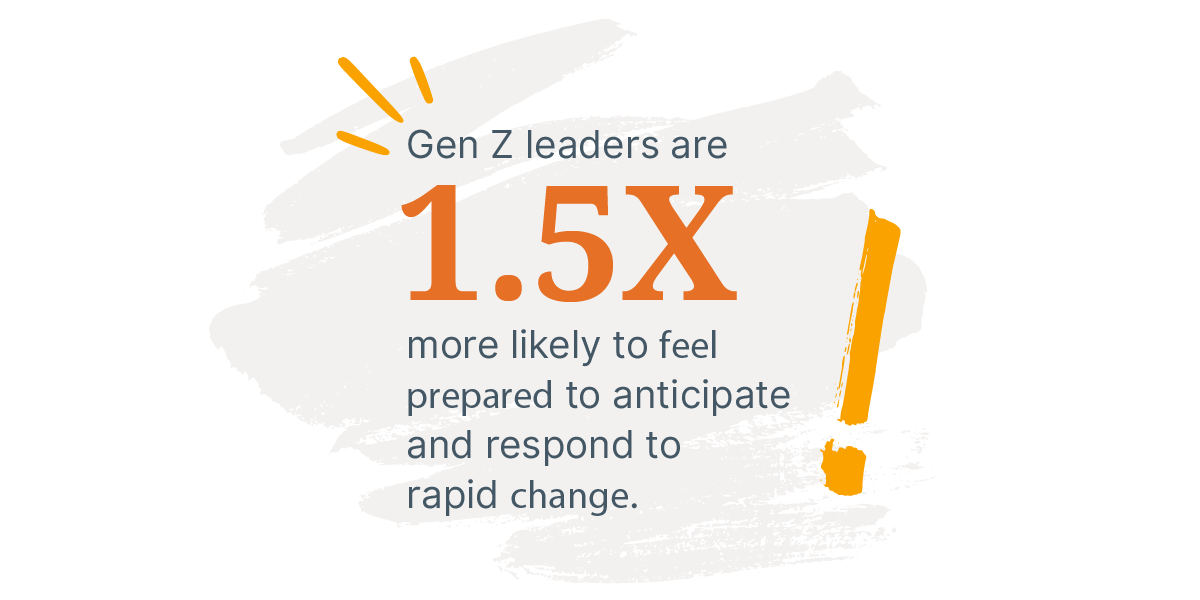
Readiness to lead change also appears higher in environments that build speed and flexibility. Gen Z leaders are 1.5X more likely to feel prepared to anticipate and respond to rapid change. According to HR, organizations with 100 or fewer employees are twice as likely as larger enterprises to report that their leaders are prepared, which may reflect fewer structural constraints that enable faster decision-making. Women also report slightly higher confidence (1.3X) in their effectiveness at managing change, though perceptions of preparedness are similar across genders.
Taken together, these patterns point to a consistent theme: Exposure to rapid change, fewer structural constraints, and opportunities to adapt in real time may help build change leadership capability. However, when leadership roles evolve faster than development approaches, experienced leaders struggle to keep pace. This underscores why organizations must rethink how they prepare leaders to lead through change.
What L&D Can Do to Build Change Leadership Capability
If change leadership is a capability problem, then L&D plays a decisive role in solving it. Our research shows that organizations with stronger, change-ready leaders take a fundamentally different approach to assessment and development, one grounded in quality, consistency, and data.
Leaders who rate their assessment and development programs as high quality are 5.6X more likely to effectively anticipate and react to change. Organizations that rely on data to guide strategic talent decisions are 3.9X more likely to report that their leaders are very capable of leading change.
To close change leadership gaps, organizations must move beyond generic training and focus on behavior-level development:
- Start with assessment to diagnose specific change leadership behaviors, not just competencies in name.
- Tie development to real change scenarios, allowing leaders to practice under realistic pressure.
- Provide feedback on observable behaviors, reinforcing what effective change leadership looks like in action.
- Leverage managers as multipliers by reinforcing development, encouraging challenge, inquiring about well-being, and creating visibility for growth opportunities.
Leading Through Change Is No Longer Optional
Change leadership is no longer a “nice to have.” Capability gaps compound when left unaddressed, undermining transformation efforts and exhausting leaders and teams alike. Organizations that invest in developing how leaders lead change—not just what they plan—are better positioned to adapt, perform, and retain talent in an environment where change is constant.
The future belongs to organizations that treat change leadership as a core capability and build it with the same rigor they apply to strategy itself.
Have a Question?
FAQs About Leading Through Change
-
What is the difference between change leadership and change management?

Change management is about the mechanics—plans, timelines, processes, and tasks that move a project from point A to point B. Change leadership is about people. It focuses on shaping direction, building commitment, influencing culture, and helping teams emotionally and behaviorally adapt. Change fails less from poor planning and more from leaders not guiding people through the human side of transition.
-
What skills do effective change leaders need?
Strong change leaders communicate purpose clearly, listen deeply, and create emotional buy‑in. They remove barriers, reinforce new behaviors, ask thoughtful questions, and engage people at every level. They also model adaptability—showing curiosity, empathy, and a willingness to challenge old norms. These behaviors matter more than authority or tenure.
-
How can organizations build change leadership capability?
Organizations must go beyond generic training and instead develop leaders through high‑quality assessment, behavior‑focused development, and real‑world practice. Using data to pinpoint specific capability gaps, giving leaders feedback on observable behaviors, and embedding managers in the development process all help build stronger, more change‑ready leaders.
-
Why are leaders struggling to lead through change?
Leaders are overwhelmed by the pace, volume, and emotional complexity of modern change. Many haven’t been equipped with the interpersonal skills needed to engage people, address resistance, or sustain momentum. The role of leadership has expanded faster than development approaches, leaving leaders underprepared and stretched thin—especially as change has shifted from occasional to constant.
-
How can leaders get better at leading through change?
Leaders can get better at leading through change by practicing the behaviors that help people understand, commit to, and sustain change. That includes clearly communicating the purpose behind change, listening to concerns, addressing resistance, involving others in solutions, removing barriers, and reinforcing new behaviors. Assessment, feedback, and practice in realistic change scenarios can help leaders identify specific gaps and strengthen these behaviors over time.